Sicilian Independence Movement
The Florios of SicilyThe Sicilian Independence Movement is the continuing struggle to restore political self-government to Sicily under Bourbon rule. In the novel, it is not an abstract national ideal detached from daily life: it emerges through disputes over who governs the island, who pays its taxes, who controls its trade and resources, and whose bodies bear the violence of occupation. From the constitutional changes of 1812 to the barricades of January 1848, the movement repeatedly exposes the gulf between Sicilian aspirations and the power exercised from Naples.
Origins in Regime Change
The movement’s political setting takes shape amid the upheavals unleashed by Napoleon Bonaparte. In 1799, the Jacobins of the Kingdom of Naples establish the Neapolitan Republic, forcing Ferdinand IV and Maria Carolina to take refuge in Palermo. They return to Naples in 1802, after the republican experiment has been crushed by fierce repression. The episode makes Palermo a refuge for a displaced royal court, even as the surrounding political order remains unstable.
That pattern recurs after Napoleon’s victory at Austerlitz. He declares the Bourbon dynasty ended and sends General André Masséna to install his brother Joseph as king of Naples. Ferdinand again flees to Palermo under British protection, while continuing to reign over Sicily. The island thus becomes both a royal sanctuary and a strategic possession, its political future shaped by powers whose military and diplomatic contests extend well beyond Sicily itself.
In 1812, resistance to an income tax imposed by Ferdinand IV precipitates a revolt. The Sicilian government promulgates a constitution drafted on the Westminster model, sharply curtailing the Bourbon king’s authority, abolishing fiefdoms, and providing for reform of the government apparatus. The stated program combines political modernization with a closer connection to Britain, which has an interest in keeping Sicily independent. The constitution gives institutional form to the claim that the island should govern itself rather than serve as an extension of royal power elsewhere.
Centralization and Its Material Costs
The constitutional settlement does not last. After the return of Ferdinand IV to Naples, his son Francesco is installed in Palermo as lieutenant-general. On December 8, 1816, the king unites the kingdoms of Naples and Sicily under one crown as Ferdinand I, king of the Two Sicilies, and annuls the 1812 constitution. The novel presents this as a decisive turn: Sicily is treated as a colony, subjected to a harsh tax regime, and stripped of the political framework that had limited royal authority.
The loss of autonomy is registered in administration as well as constitutional language. From December 1816, Neapolitans staff state offices and customs posts, and Neapolitans command the military. Palermo loses its power and independence; heavier taxes, trade restrictions, and new constraints deliver what the narrative calls the final blow to an already faltering economy. The collapse of political authority into centralized control is therefore also a commercial crisis. Customs, taxation, and access to markets become everyday instruments through which the island experiences subordination.
The novel links these pressures to the fragility of merchant life. In Palermo, the Florios’ accounts reveal a business facing payouts greater than its earnings and letters of credit close to expiry. Their trade depends on movement through ports, warehouses, and customs systems, so administrative restrictions can turn political change into immediate financial danger. Their circumstances do not make them leaders of the independence movement; rather, they show why a merchant might recognize the costs of rule from Naples while remaining cautious about revolutionary commitments.
That tension sharpens as the Florios expand. Their spices pass through an international chain of suppliers and ports, and their warehouse within the Palazzo Steri property holds goods destined for other ports or awaiting sale. The merchandise comes through British and French networks and is stored under arrangements that defer import tariffs until goods enter Palermo. The business’s growth depends on navigating precisely the commercial structures that political centralization can constrain. Independence consequently signifies not only a constitutional principle but the possibility of local control over the conditions of trade.
The Revolution of 1848
The failed uprising of 1837 remains part of the political memory behind the next revolt. By 1847, protests are again occurring across Sicily, driven by poverty, demands for independence, and social conflict. Ferdinand II’s repressive attitude intensifies public anger. In the city, proclamations calling people to arms are torn down and trampled by royal guards; rumors circulate that any uprising will be met with rifle fire and hangings from naval frigates. The movement’s language of self-government develops under the immediate threat of military punishment.
On January 12, 1848, Giuseppe La Masa and Rosolino Pilo lead an insurrection in Palermo. The city becomes the first large city in Italy to declare independence from central power. Admiral Ruggero Settimo heads the revolutionary government, which, with support from aristocrats and the bourgeoisie, attempts to bring the people into political decision-making. Ferdinand grants a constitution, and the Sicilian revolt forms part of a wider revolutionary wave: other Italian states follow with constitutional concessions and rebellions, while upheaval reaches across Europe.
The novel brings the public crisis into a household through Giulia Portalupi. She has seen the notices posted around the city and asks her brother Giovanni whether they are cause for concern. He explains the grievances beneath the proclamations: Neapolitans hold administrative posts, Sicilians face double taxation on grain, and women suffer abuse by Neapolitan soldiers, while husbands who protest risk imprisonment in the Vicaria. He also describes a small group of nobles and middle-class intellectuals who hope to lead the people in taking control of their own destinies. The movement is presented through competing social positions: Giulia’s sheltered domestic life, Giovanni’s political awareness, and the public’s accumulated anger.
When gunfire confirms that the rebellion has begun, Giulia recognizes that her brother’s warning was right. It is the king’s official birthday, January 12, and she orders the windows shut and her children dressed to leave. Her response gives the uprising an intimate consequence before it appears as a political spectacle: the possibility of revolt immediately becomes a question of family safety.
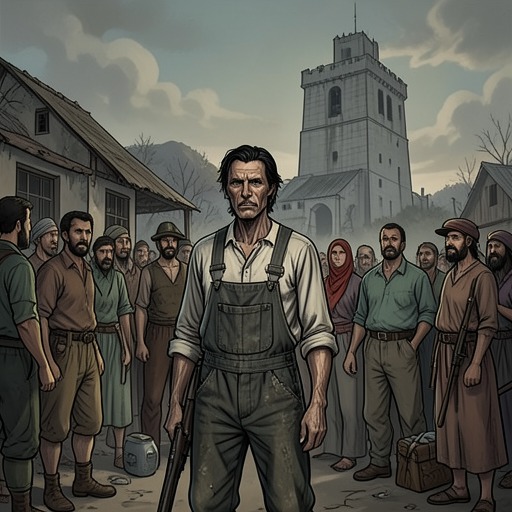
Vincenzo Florio, meanwhile, first acts to protect his commercial property. Hearing that the sounds are coming from La Cala, he tells his employees to secure the premises and goes to the aromateria. He borrows a cloak to avoid recognition and heads through the alleys toward the Oretea foundry, intending to have its gates barred and its most important tools put away. A barricade blocks his way at Via Bambinai, where men are firing at Bourbon troops. The danger to the foundry and the danger of the street meet in one scene: the commercial world cannot remain separate from the armed struggle unfolding around it.
Alliance, Division, and Defeat
At the barricade, a young rebel accuses Vincenzo of believing that wealth gives him the right to go wherever he pleases and points a pistol at his chest. Giuseppe La Masa arrives with armed men and stops the confrontation. He identifies Vincenzo as the owner of Casa Florio and challenges the rebels’ treatment of him, then presses the merchant to support the cause. La Masa’s appeal connects the movement’s political claims to Vincenzo’s practical interests: Sicilians are abused by Neapolitan officials, deprived of freedom, taxed heavily, and treated as inhabitants of a land to conquer and exploit. He also invokes the dishonoring of young women by the king’s soldiers. The appeal widens from Palermo to the island as a whole and asks whether Vincenzo will contribute his resources and intelligence to building a new Sicily.
The encounter reveals the movement’s difficult relationship with wealth. La Masa sees a capable entrepreneur as a potential partner whose resources could help the cause; the armed rebel sees a rich man who expects deference. Vincenzo’s first concern has been safeguarding his enterprise, yet he cannot avoid the question of political responsibility once the barricade and the people’s grievances stand directly in his path. The scene gives the movement a concrete social location: it is voiced by armed insurgents and a patriot, but it must negotiate with merchants whose economic power is useful and whose interests do not necessarily coincide with the people’s demands.
The revolutionary coalition is fragile. Sicily’s cities are divided, and the uprising contains incompatible goals. Aristocrats and the bourgeoisie seek wealth through the acquisition of Church property, while the people hope for redistribution of land. The conflict is not simply between Sicilians and Bourbon authority; class interests divide those challenging the regime. By May 1849, weakened and pursued by Bourbon troops, the revolutionary administration surrenders. Ferdinand II does not sentence the revolt’s leaders to death, but sends them into exile, and grants a royal pardon to supporters. The movement loses its immediate political contest, while its leaders are removed from the island and its social divisions remain unresolved.
Commerce, Coercion, and the Movement’s Legacy
The later consequences of political upheaval continue to intrude on the Florio business. During Garibaldi’s occupation, Bourbon authorities requisition three of the family’s five steamers for transporting troops, and one steamer is sunk. A year later, the authorities also contest the interruption of the mail-distribution service and seek to fine Vincenzo for missed services, though the official forms and stamps needed for distribution had not arrived in time. The dispute shows how regimes claim commercial assets and enforce administrative obligations even when state action has caused the loss. For Vincenzo, the change of government does not erase the consequences of coercion; it adds new claims to the damage already suffered.
The movement’s history therefore resists a simple opposition between political ideal and private interest. The Florios’ commerce depends on shipping, customs arrangements, and official agreements, all of which are vulnerable to changes in sovereignty. Vincenzo’s experience of revolutionary disorder leads him, at fifty, to take a job with the National Guard after the revolutionary leaders flee and the city collapses into disarray. He does not want the position, but feels he has no choice; he distances himself from the revolutionary government’s actions as soon as he can and believes he has not mismanaged his business. Political participation appears less as a settled allegiance than as a forced accommodation to circumstances.
Across these episodes, Sicilian independence is both a constitutional demand and a dispute over material power. The 1812 constitution promises limits on monarchy and reform; its annulment places administration, customs, taxation, and military command under Neapolitan control. In 1848, the proclamations and barricades make that structure visible in the streets, while the rebels’ appeal to Vincenzo exposes the uneasy bargain between popular revolt and commercial wealth. The movement’s defeat in 1849 does not resolve the grievances that generated it. Instead, the novel keeps returning to the way political authority reaches into trade, family safety, and the lives of those who must decide whether to resist, cooperate, or simply protect what they can.